By Dennis Gichuiri
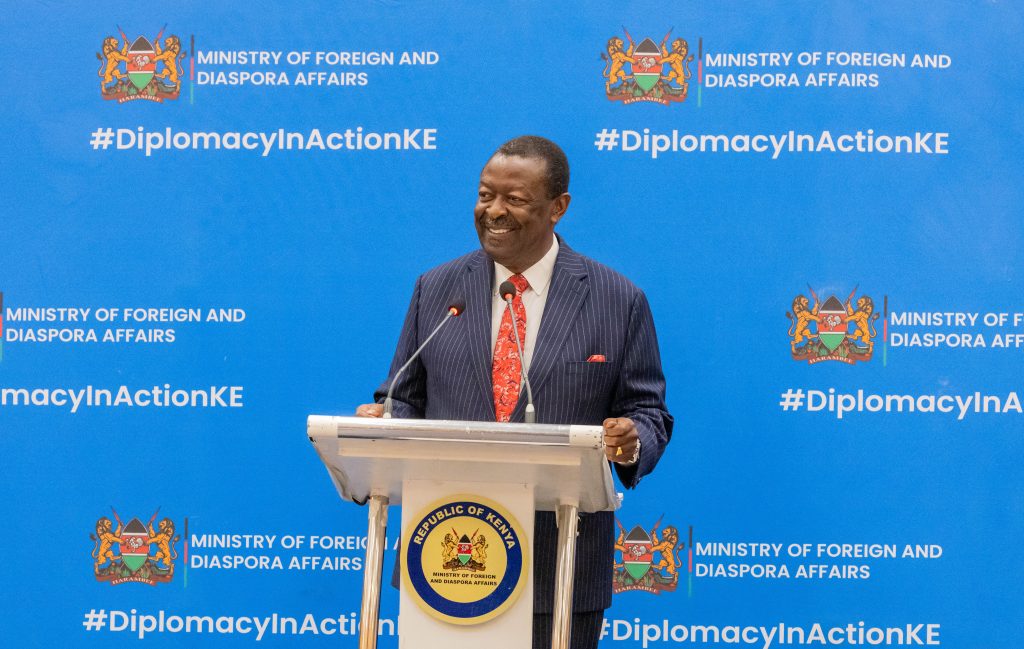
Prime Cabinet Secretary and Cabinet Secretary for Foreign and Diaspora Affairs Musalia Mudavadi has assured Kenya’s diplomatic partners of the country’s political stability, economic resilience and continued commitment to regional integration, peace and security.
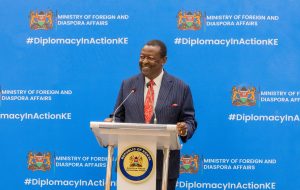
Speaking during the quarterly Diplomatic Briefing to the Diplomatic Corps at Serena Hotel, Nairobi, Mudavadi outlined Kenya’s priorities as the country prepares for the 2027 General Election while positioning the country as a key economic, diplomatic and security hub on the continent.
Mudavadi said the Government was committed to ensuring that the August 10, 2027 General Election is safe, free and peaceful, urging the diplomatic community to support Kenya’s constitutional institutions and democratic processes.
“The Electoral Commission must be allowed to discharge its constitutional mandate independently and professionally. We should not seek to discredit the Commission,” Mudavadi said.
He said democracy is sustained by strong institutions and respect for established rules rather than individual interests, adding that the Government was strengthening inter-agency coordination to identify and address emerging security threats ahead of the elections.
He pointed to the launch of the Uchaguzi Bila Noma roadmap by the National Cohesion and Integration Commission as part of efforts to promote a violence-free electoral process.
“Those who threaten peace and security will be held firmly accountable in accordance with the law, regardless of their political affiliation and status in society,” he said.
Economy remains resilient
On the economy, Mudavadi presented Kenya as a resilient and increasingly attractive destination for investment, noting that real Gross Domestic Product grew by 5.3 per cent in the first quarter of 2026, compared with 4.9 per cent during the corresponding period the previous year.
He said foreign exchange reserves stood at US$14.9 billion, equivalent to 6.2 months of import cover, while the Nairobi Securities Exchange crossed the KSh4 trillion market capitalisation mark for the first time.
Mudavadi called on the diplomatic community to deepen engagement with the Kenya Development Corporation and the Nairobi International Financial Centre to facilitate investment linkages between Kenya and their respective countries.
He said Kenya was seeking to diversify and increase value-added exports, expand trade and investment, facilitate technology transfer, advance the digital economy and strengthen local manufacturing.
“Kenya is more than a destination for capital. It is strategically positioned to serve as a manufacturing base and a launchpad for digital growth across the continent,” Mudavadi said.
He also highlighted the Government’s efforts to establish long-term financing mechanisms through the National Infrastructure Fund and Sovereign Wealth Fund, inviting international partners to explore public-private partnerships and co-investment opportunities.
Kenya clarifies position on EAC nationals
Mudavadi also used the diplomatic forum to clarify Kenya’s position on the recent measures affecting small-scale trade and informal retail.
He said the directives announced by President William Ruto on September 2 were intended to protect vulnerable sectors of the economy, promote fair competition and safeguard the livelihoods of Kenyan citizens.
Importantly, he stressed that Kenya was not implementing a blanket ban on foreign nationals engaging in small-scale business.
“Kenya is open to small and large-scale trade by foreign nationals, as long as they are compliant with immigration, work-permit, registration and licensing requirements,” he said.
He described Kenya’s approach as regulatory rather than discriminatory and reaffirmed the Government’s commitment to safeguarding the rights and businesses of foreign nationals.
Regional integration at the heart of Kenya’s diplomacy
Mudavadi reaffirmed Kenya’s commitment to the African Union, East African Community, IGAD, ICGLR and the African Continental Free Trade Area.
He said regional integration remained a cornerstone of Kenya’s foreign policy, with the country preparing to host the 4th COMESA-EAC-SADC Tripartite Summit in Nairobi.
The three regional blocs bring together 29 countries, more than 700 million people and a combined GDP exceeding US$1.4 trillion.
Mudavadi said Kenya’s ambition was to see an Africa where African goods are produced on the continent, traded across African markets and increasingly consumed within Africa.
He also announced Kenya’s increased commitment to the African Union through its voluntary move to Tier One of the AU scale of assessment, with its annual contribution expected to rise to approximately US$14.6 million from 2027.
Diaspora as engine of investment and skills
Turning to the Kenyan diaspora, Mudavadi described Kenyans abroad as an increasingly important source of investment, innovation, skills and expertise.
He said the Government was implementing a Diaspora Investment Strategy and establishing a Diaspora Investment Support Office to strengthen engagement with Kenyans abroad.
He further called for stronger international cooperation on labour mobility, mutual recognition of qualifications, research, skills development, technology transfer and technical and vocational education and training.
“We welcome collaboration in research, skills development and technology transfer,” he said, describing Kenya’s workforce as young, skilled and adaptable.
Kenya pushes African-led solutions to security challenges
On peace and security, Mudavadi reiterated Kenya’s position that African challenges require African-led solutions.
He said Kenya remained concerned about terrorism and transnational crime across the continent and called for stronger international and regional cooperation in counterterrorism, including efforts to prevent terrorist financing, recruitment and radicalisation.
On Somalia, Kenya called for adequate funding for the African Union Support and Stabilisation Mission and implementation of UN Resolution 2719 on financing African Union-led peace support operations.
On Sudan, Mudavadi said the conflict could not be resolved through military means and required a coordinated mediation process alongside a humanitarian truce.
He also highlighted the risks posed by instability in the Middle East to maritime trade, energy and global commodity supply chains, reaffirming Kenya’s support for freedom of navigation under international law.
Kenya steps up climate and health preparedness
Mudavadi also addressed emerging challenges facing the country, including food security, climate change and the Ebola outbreak in the region.
He said below-average rainfall in Kenya’s cereal-producing regions had resulted in widespread crop failure, with national harvest projections indicating a 30 to 40 per cent decline in food production this year.
The Government, he said, was responding through subsidised fertiliser, support for certified maize seed, increased investment in irrigation and preparations for possible maize imports to cushion the country against food shortages and price distortions.
Kenya is also leading negotiations towards a Protocol on Drought Management and advocating for greater international financing for drought resilience and climate adaptation.
On Ebola, Mudavadi said Kenya had no reported cases but remained on heightened preparedness, with surveillance and passenger screening maintained at major entry points, including Jomo Kenyatta International Airport.
Kenya champions multilateralism
Mudavadi said Kenya remained firmly committed to multilateralism as the most effective framework for confronting global challenges.
He invited the diplomatic community to participate in the inaugural Global Trust Summit, scheduled for October 22–23, 2026 in Nairobi, as well as the inaugural Diplomatic Conference on the Provision, Administration and Management of Privileges and Immunities to the Diplomatic Community in Kenya, scheduled for November 23–24.
He also sought diplomatic support for Kenya’s international candidatures, including Judge Phoebe Okowa’s candidature to the International Court of Justice and Justice Njoki Ndung’u’s candidature to the International Criminal Court.
Mudavadi further highlighted Kenya’s contribution to international peace and security, including its role in peacekeeping, mediation, counterterrorism and support for refugees.
He said Kenya’s foreign policy was anchored in respect for international law, human rights, peace, stability and democratic governance.
“Kenya is also a country that honours its commitments. We respect international law, uphold human rights and defend the rule of law,” Mudavadi said.
He assured the diplomatic community that Kenya would continue providing a conducive, secure and predictable environment for diplomatic missions and international organisations operating in the country.
As he closed the briefing, Mudavadi reaffirmed Kenya’s openness to investors, partners and the international community, portraying the country as both an economic gateway and a strategic platform for Africa’s future.
The briefing brought together ambassadors, high commissioners, representatives of international organisations and senior Kenyan officials.