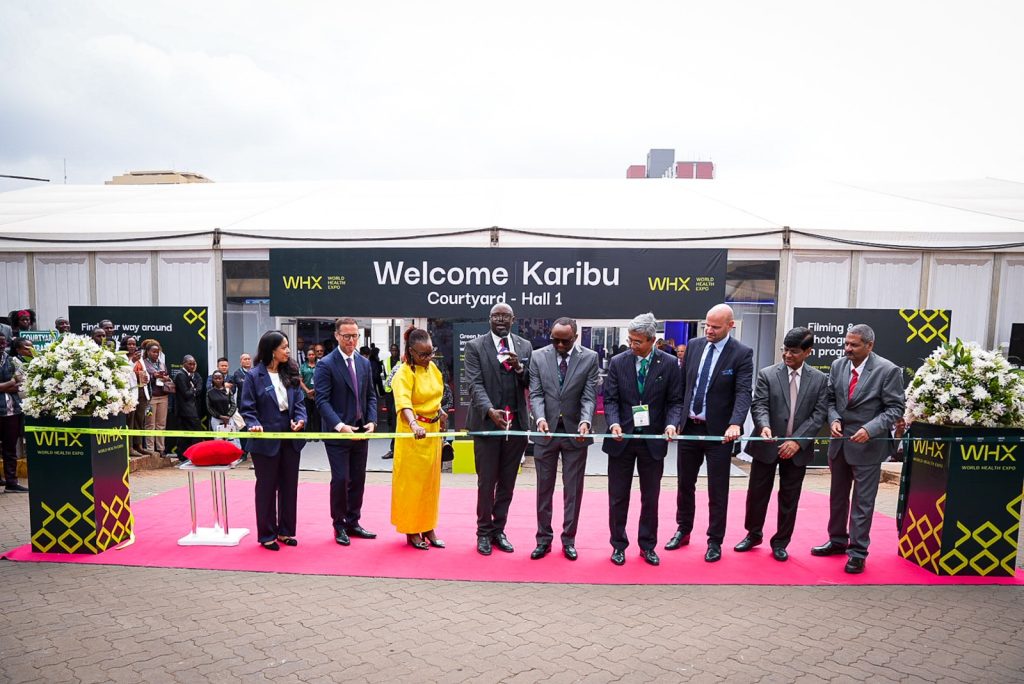
NAIROBI, KENYA — Kenya is seeking to position itself as a leading healthcare manufacturing and investment hub in East Africa as global medical technology companies, pharmaceutical firms and healthcare investors converge in Nairobi for the World Health Expo (WHX) 2026.
The four-day exhibition, which opened on Wednesday at the Kenyatta International Convention Centre (KICC), has brought together companies and healthcare stakeholders from about 25 countries, creating opportunities for investment, local manufacturing, procurement and cross-border partnerships.
The Ministry of Health is using the expo to push for deeper collaboration between international manufacturers and Kenyan healthcare institutions, with a focus on technology transfer, local skills development, maintenance capacity and the procurement of locally made healthcare products.
Principal Secretary for Public Health and Professional Standards Mary M. Mugo said international exhibitors should be viewed as strategic partners in transforming healthcare delivery rather than simply suppliers of medical equipment.
“To our international guests from across Africa, Asia, Europe and the Americas, we welcome you not merely as visitors to an exhibition but as strategic partners in transforming healthcare delivery across Kenya and the continent,” Mugo said in remarks delivered during the official opening.
The PS said Kenya’s healthcare sector presents opportunities that go beyond the supply of equipment, particularly as the country implements reforms aimed at expanding access to healthcare and strengthening primary healthcare.
Under the government’s Bottom-Up Economic Transformation Agenda, Kenya is implementing the Primary Healthcare Act, Social Health Insurance Act, Digital Health Act and Facility Improvement Financing Act.
The reforms are increasing demand for medical equipment, diagnostics, pharmaceuticals, digital health technologies and other healthcare products across the country’s 47 counties.
Mugo said more than 107,000 community health promoters have been trained, equipped and deployed, with each promoter provided with an integrated digital smartphone to support household-level healthcare.
However, she noted that expanding healthcare access also requires reliable physical infrastructure and locally sustainable supply chains.
“Policy must be matched by practical tools,” Mugo said, pointing to the need for reliable diagnostic equipment for community health promoters, surgical equipment and medical oxygen for rural maternity units, as well as functional laboratory equipment, reagents and reliable power.
Push for Local Manufacturing
The growing demand presents an opportunity for Kenya to expand domestic production of medical devices, equipment, pharmaceuticals and other healthcare products, reducing exposure to import-related supply disruptions and creating a stronger regional manufacturing base.
The government is encouraging international companies participating in WHX Nairobi to explore partnerships that can transfer technology and technical expertise to Kenyan manufacturers and institutions.
The Ministry is also calling for greater engagement between manufacturers and public health buyers to improve procurement efficiency and ensure healthcare institutions have access to equipment suited to local operating conditions.
Mugo highlighted India’s participation in the expo, including the Export Promotion Council for Medical Devices and Andhra Pradesh MedTech Zone (AMTZ), as an example of the type of international collaboration Kenya is seeking.
She said India’s medical technology ecosystem offers opportunities for partnerships around cost-effective healthcare solutions while encouraging direct engagement between manufacturers and public health buyers.
“Such partnerships can reduce unnecessary intermediary costs,” she said.
The emphasis on direct manufacturer-to-buyer relationships could also support import substitution by creating opportunities for Kenyan institutions to source more healthcare products from local manufacturers and regional suppliers.
From Equipment Sales to Long-Term Partnerships
The Ministry is also pushing manufacturers to rethink how medical equipment is supplied and maintained in African markets.
Mugo warned against a situation where expensive medical equipment becomes unusable because of a lack of spare parts, maintenance services, reliable power or technical expertise.
“Africa must no longer be an equipment graveyard,” she said.
She called on manufacturers, aggregators and vendors participating in WHX Nairobi to provide comprehensive service-level agreements covering maintenance and spare-parts availability.
The government is further seeking technology-transfer agreements and training programmes for Kenyan and African biomedical engineers and technicians.
It also wants partnerships to establish mobile and stationary calibration laboratories to ensure medical equipment remains safe, accurate and operational throughout its intended lifespan.
For healthcare procurement officers, the Ministry is encouraging a shift from focusing solely on the initial purchase price to assessing the total cost of ownership.
This includes evaluating equipment’s energy efficiency, maintenance requirements, availability of spare parts and the training support provided by suppliers.
Nairobi as a Regional Healthcare Marketplace
With exhibitors and healthcare stakeholders from Africa, Asia, Europe and the Americas, WHX Nairobi is also strengthening Nairobi’s role as a marketplace connecting global healthcare manufacturers with East African buyers.
The participation of international companies provides an opportunity for Kenyan firms to develop distribution, manufacturing, technology and service partnerships that can extend beyond the domestic market into the wider East African Community.
The cross-border approach could support the development of regional healthcare supply chains in which Kenya serves as a manufacturing, distribution and innovation base.
For local manufacturers, greater integration with international companies could provide access to technology, capital, technical skills and regional markets. For international firms, partnerships with Kenyan companies and institutions offer a potential route into one of Africa’s growing healthcare markets.
The government says the ultimate objective is to translate the partnerships developed at WHX Nairobi into stronger local manufacturing capacity, more resilient supply chains and better-equipped healthcare facilities.
As global healthcare players meet in Nairobi, the focus is therefore shifting from Kenya being primarily a market for imported medical products to developing its capacity as a manufacturer, procurement market and regional distribution centre for healthcare solutions.