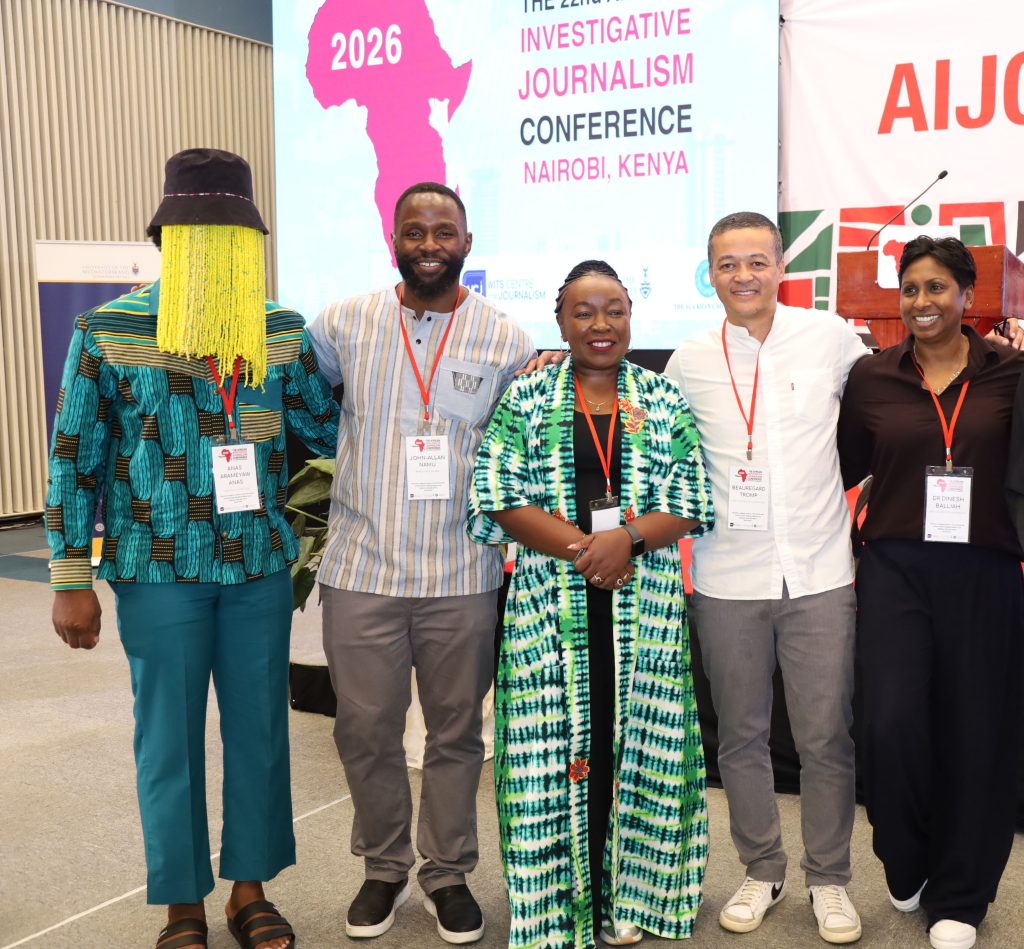
Investigative Journalists Anas Aremeyaw Anas, John Allan Namu, Aga Khan University Graduate School of Media & Communication Dean Prof. Nancy Booker, African Investigative Journalism Conference (AIJC) Convenor Beauregard Tromp & Wits Centre for Journalism Director Dinesh Balliah during the 22nd Africa Investigative Journalism Conference that brought together 450 journalists, editors, trainers and other media professionals to explore critical issues shaping the future of investigative journalism
Kenya has made history by hosting the African Investigative Journalism Conference (AIJC) for the first time in the event’s 22-year history, bringing together 450 journalists from 50 countries in Nairobi.
The three-day conference, which opened on November 10, 2026, is being hosted by the Aga Khan University Graduate School of Media and Communications (AKU-GSMC) in partnership with the Wits Centre for Journalism.
The gathering at the Edge Convention Centre marks the first time the annual conference has been held outside South Africa, where it has traditionally been hosted.
Journalists, editors, trainers and other media professionals are attending the meeting to discuss emerging challenges and opportunities in investigative reporting, including artificial intelligence, open-source intelligence, data journalism, cross-border investigations, journalists’ safety and environmental reporting.
Aga Khan University Graduate School of Media and Communications Professor and Dean Nancy Booker said the conference reflects the institution’s commitment to strengthening investigative journalism and preparing the next generation of reporters.
“At the Aga Khan University Graduate School of Media and Communication (AKU GSMC), we see strong investigative journalism as essential to a well-informed public and accountable societies,” Booker said.
She added that bringing the conference to Nairobi would help bridge the gap between academic training and newsroom practice by giving upcoming journalists an opportunity to learn from experienced practitioners.
The conference comes amid growing efforts to strengthen investigative journalism across Africa, with more organisations and independent centres emerging to support accountability reporting.
A study by the Fojo Media Institute and Wits Journalism identified 32 investigative journalism hubs across 19 of the 42 countries in sub-Saharan Africa.
Wits Centre for Journalism Director Dr Dinesh Balliah said the partnership with Aga Khan University provided an opportunity to take the conference beyond its traditional South African base and showcase the work of African journalists.
“The Wits Centre for Journalism is proud to partner with Aga Khan University to host AIJC 2026. This is the first time the conference will be held outside Johannesburg, and I am confident it will be a success, given Kenyan hospitality,” Balliah said.
He described the gathering as an important platform for journalists committed to holding those in power accountable, while highlighting the work of reporters operating in difficult conditions.
The programme will also examine the growing influence of technology on journalism and the need for stronger collaboration across borders as investigative stories increasingly involve complex networks and institutions.
One of the key sessions, scheduled for November 11, will focus on an investigation titled Kenya’s AI Health System That Makes the Poor Pay.
The session will examine how Kenya’s system for calculating public healthcare premiums was investigated, bringing attention to questions surrounding the use of artificial intelligence and the impact of healthcare financing decisions on vulnerable populations.
The conference is expected to provide a platform for sharing investigative techniques, building professional networks and strengthening collaboration among journalists working across Africa and beyond.