By Reuben Mwangi, Group Managing Director, Bridge International Academies Foundation
Across sub-Saharan Africa, getting children into school has been one of the great successes of the past two decades. The harder test is ensuring they learn once they are there.
The World Bank estimated in 2022 that 89 per cent of children in sub-Saharan Africa were experiencing learning poverty, meaning they could not read and understand a simple text by age 10.
That is not a story about weak children or low ambition. It is the gap between going to school and actually learning in school.
What closes that gap is a teacher who is well trained, equipped with effective tools and supported consistently. Every other investment in education ultimately depends on that relationship.
This World Teachers’ Day, on October 5, we should say it plainly: a great teacher can change a child’s future.
Teachers are role models who provide guidance, direction and the confidence to learn. They help children find purpose, prepare them to become responsible citizens and inspire them to strive for better futures. When a teacher refuses to give up on a struggling reader, a future can change.
At Bridge International Academies Foundation, a non-profit organisation delivering education in underserved communities across Kenya, we see this every day. Pupils with well-trained and supported teachers learn more. That is why we invest in teachers’ capacity development throughout their careers.
To date, more than 19,410 teachers and school leaders have been supported through our capacity-building programmes.
Our training is designed to mirror the classroom. It focuses on four practical skills: delivering lessons using teacher guides, checking whether every child is learning, providing feedback that accelerates progress, and motivating pupils to work hard and behave well.
Teachers practise the same approaches they will use with their pupils. Trainers demonstrate each skill, guide teachers through it, observe them practising and provide immediate feedback. There is less lecturing and more hands-on practice, followed by continued coaching once teachers return to their classrooms.
The same approach shapes the learning experience for pupils.
Lessons are carefully sequenced, children are given time to think before answering questions, and teachers move around classrooms to ensure that no learner is left unsupported. Techniques such as cold calling keep all pupils engaged and ready to respond, while recognising effort reinforces positive learning behaviours.
None of these approaches is complicated. What makes them effective is repetition — practising during training, observing implementation in the classroom and providing coaching until good practice becomes instinctive.
Technology supports this process, but it does not replace the teacher.
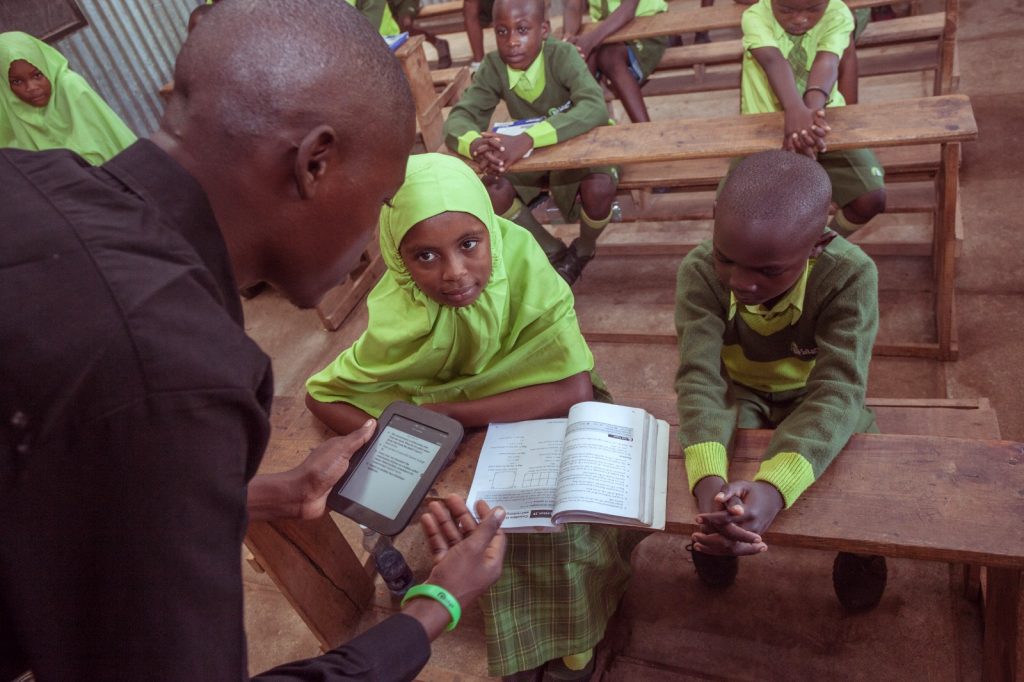
Every teacher has a digital handheld tablet with lesson guides aligned with Kenya’s Competency-Based Education system. Dashboards can also flag learners who are falling behind, allowing teachers to identify where additional support may be needed.
The purpose is simple: to give teachers more time, information and support to make better decisions in the classroom.
Evidence also points to the potential impact of this approach. An independent study led by Nobel laureate Professor Michael Kremer found that children in Bridge schools in Kenya gained 53 per cent more learning across their pre-primary and primary years. After two years, primary pupils had gained the equivalent of an additional year of learning compared with peers in other schools, while the gain among pre-primary pupils was nearly one and a half years.
Bridge has also reported strong examination outcomes among its pupils. In 2025, 88.64 per cent of its primary learners — roughly nine in 10 — met or exceeded expectations in their level examinations, with both girls and boys recording strong results.
The lessons extend beyond individual schools.
For education leaders in Kenya and across the region, the question should not simply be how much we invest in education, but how effectively that investment reaches the classroom.
Sustained coaching, practical professional development and timely feedback can help teachers translate training into better classroom practice. Classroom data should help teachers identify where pupils need support rather than become another mechanism for policing performance.
Technology should give teachers better tools and information to make decisions, while keeping the teacher firmly at the centre of learning.
And every education reform should ultimately be judged by one question: What are children actually learning?
Achieving this requires a shared commitment.
Governments can build strong systems for teacher preparation, development and support. Schools and education organisations must give teachers the time, tools and coaching they need to improve their practice. Parents, communities and employers can help strengthen the status of teaching as a profession.
When we invest in teachers in this way, we invest directly in the quality of learning.
Enrolment opened the door. Teachers are how children walk through it and learn.
This World Teachers’ Day, recognising teachers should mean more than thanking them. It should mean giving them the training, tools, feedback and professional support they need to help every child learn, grow and dream big about their future.