By Shadrack Nyakoe
The Institution of Surveyors of Kenya (ISK) has backed the government’s push to reclaim riparian reserves along Nairobi’s river corridors, but warned that ongoing demolitions risk violating property rights if due process and compensation are not observed.
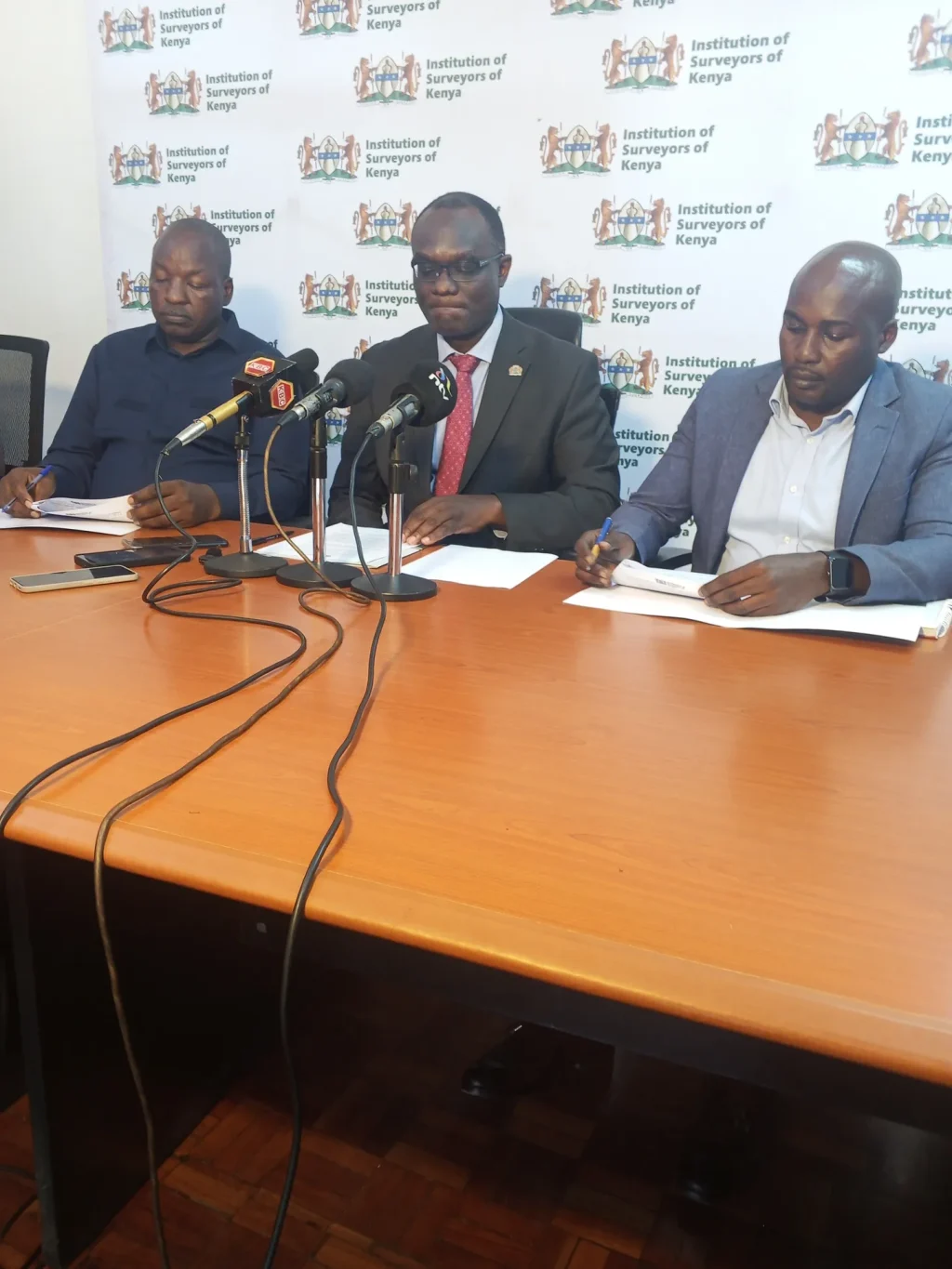
In a statement issued Tuesday, ISK said it supports efforts by the Ministry of Lands and the Nairobi Rivers Regeneration Project to restore degraded waterways, mitigate flooding, and protect ecosystems in line with the Constitution.
However, the professional body raised concern over what it termed as inconsistencies in defining and measuring riparian reserves, saying the lack of harmonised standards has contributed to encroachment, disputes, and confusion in enforcement.
The statement comes amid heightened public debate following recent remarks by Johnson Sakaja and a wave of demolitions targeting structures deemed to be on riparian land.
ISK noted that multiple laws and differing technical interpretations—ranging from setback distances to reference points such as riverbanks and high-water marks—have created uncertainty around the true extent of protected areas.
“Effective management of riparian reserves has been hampered by conflicting legal frameworks and inconsistent technical standards,” the body said.
Property rights and compensation
The surveyors’ body challenged the assumption that all riparian reserves constitute public land, arguing that some may legally fall under private ownership, depending on how they were surveyed, allocated, and registered.
It emphasised that properties acquired and developed lawfully under previous regimes cannot be subjected to new regulations retroactively without compensation.
According to ISK, any state action resulting in loss of land or use amounts to compulsory acquisition and must comply with constitutional provisions, including prompt and full compensation.
“The sanctity of title deeds must be respected,” the statement said, adding that demolition should only occur after valuation, legal notices, and due process have been followed.
However, the institution drew a distinction for illegally or fraudulently acquired land, stating that such properties do not qualify for constitutional protection and may be removed in accordance with the law.
Call for harmonisation
To address the ongoing disputes, ISK called for urgent harmonisation of laws governing riparian reserves, including the Survey Act, Environmental Management and Coordination Act, Water Act, and Land Act.
It also urged the government to develop clear national guidelines on defining, measuring, and managing riparian zones, as well as to publish comprehensive boundary maps prepared by licensed surveyors.
Further, the institution insisted on strict adherence to due process, including public participation, adequate notice, and access to legal redress before any enforcement action is taken.
Flooding concerns
Beyond enforcement, ISK linked the recent flooding in parts of Nairobi to broader planning failures, including poor drainage systems, unchecked development, and environmental degradation.
The body proposed measures such as geospatial mapping of flood-prone areas, improved stormwater management, and stricter enforcement of zoning laws.
It also called for simple interventions like unclogging drainage systems and curbing waste dumping into rivers as immediate solutions.
Commitment to collaboration
ISK said it is ready to work with government agencies, counties, and communities to ensure that riparian demarcation balances environmental protection with property rights and legal safeguards.
“Sustainable environmental management must not come at the expense of constitutional guarantees or public confidence in land administration,” the statement said.