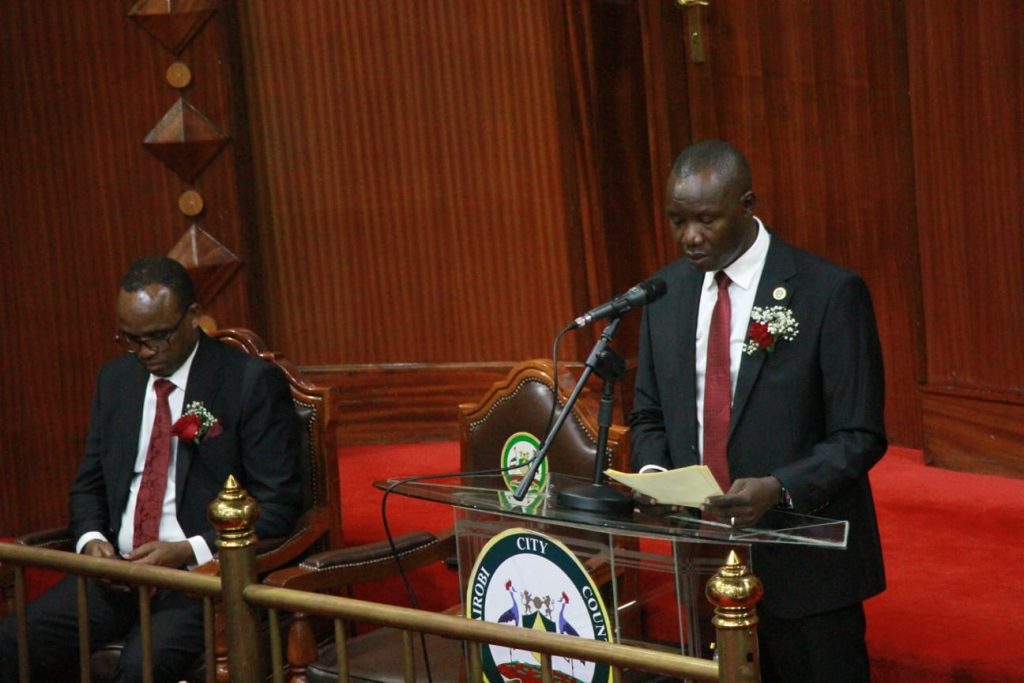
Nairobi County Executive Committee Member for Finance Ibrahim Auma on Tuesday presented his maiden budget since taking over the county treasury, unveiling a KSh49.27 billion spending plan.
The new CECM has set an ambitious own-source revenue target of KSh20.86 billion for the 2026/2027 financial year.
The budget marks Auma’s first major assignment after replacing Charles Kerich as the county’s Finance Executive and will serve as the financial blueprint that guides Governor Johnson Sakaja’s administration through its final full financial year before the August 2027 General Election.
As the new custodian of the county’s finances, Auma will now be tasked with overseeing the implementation of the budget and ensuring the administration delivers on its development promises.
While presenting the estimates before the Nairobi County Assembly, Auma said the county projects total revenues of KSh49.27 billion, comprising KSh20.86 billion from own-source revenue, KSh23.47 billion from the equitable share and grants, KSh2 billion from the Health Facilities Improvement Fund.
The county also targets to gain from liquor licensing revenue, and KSh1.7 billion from cash balances.
He maintained that the county intends to expand its revenue base without increasing county taxes, fees or charges.
He allocated KSh34.36 billion for recurrent expenditure and KSh14.91 billion—about 30 percent of the total budget—for development projects.
Key allocations include KSh2.4 billion for roads, drainage, bridges and street lighting, KSh2.255 billion for Ward Development Projects, KSh1.06 billion for the construction and rehabilitation of health facilities including Pumwani, Mutuini and Mama Lucy Kibaki hospitals.
He also allocated KSh900 million for the Dishi na County school feeding programme, KSh793 million for bursaries, KSh491 million for market development, KSh190 million for the Biashara Stimulus Programme, KSh5.3 billion for environmental services and solid waste management, and KSh4.5 billion for the Nairobi County Assembly.
However, Auma’s revenue projections are expected to attract close scrutiny after the county collected about KSh13 billion in own-source revenue in the previous financial year.
To bridge the gap, he said the county will operationalize the Nairobi City County Revenue Authority, expand digital revenue collection systems, roll out Unified Business Permits, strengthen land rates administration and enhance revenue compliance.
He also pledged to prioritize the settlement of long-standing pending bills, saying restoring confidence among suppliers remains critical to improving service delivery and the county’s financial health.