Artificial intelligence is no longer a futuristic concept confined to technology in laboratories. It is increasingly becoming part of the way diseases are detected, patients are monitored, medicines are developed and health systems are managed.
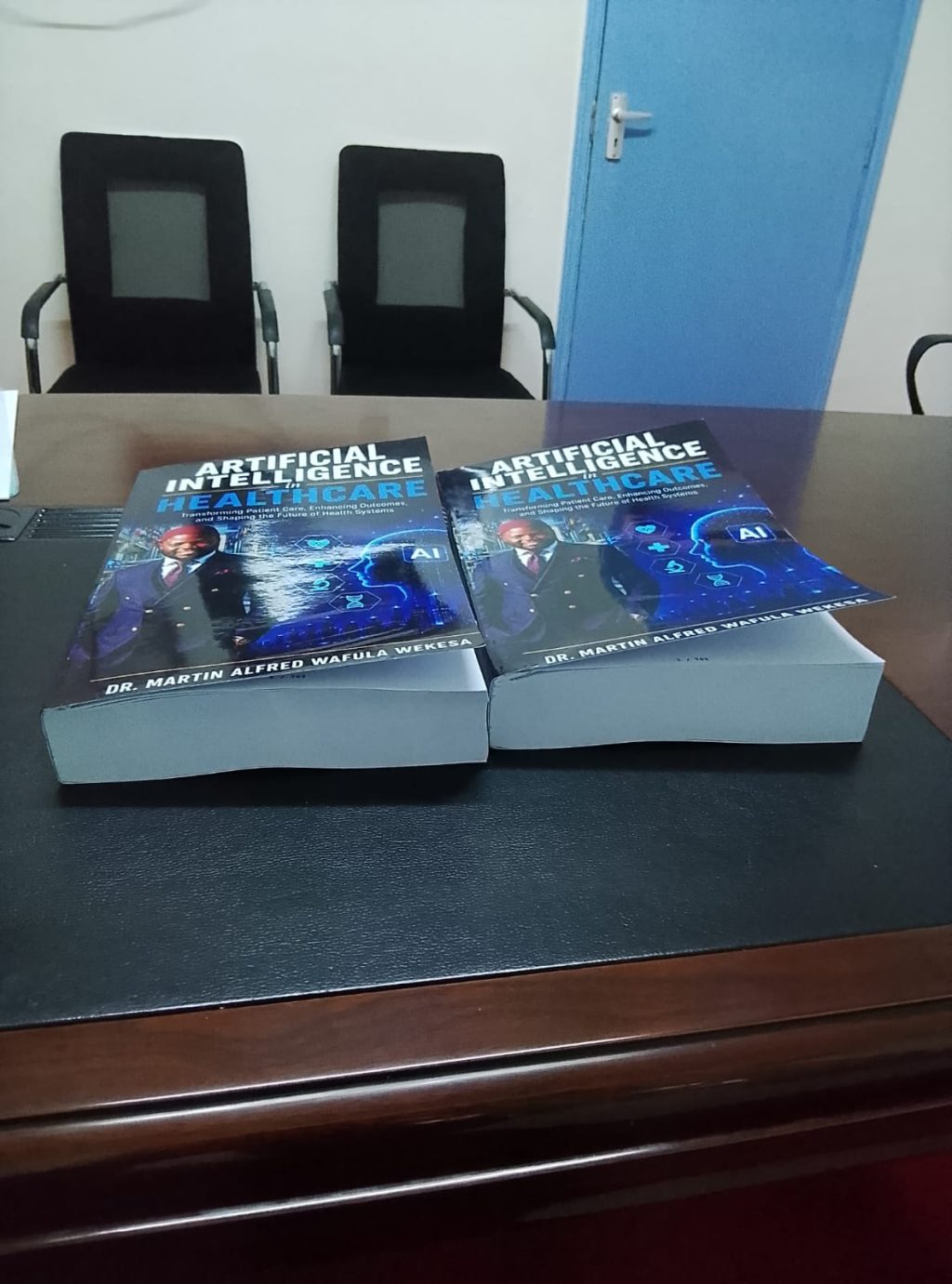
It is against this rapidly changing backdrop that Dr Martin Alfred Wafula Wekesa has authored Artificial Intelligence in Healthcare: Transforming Patient Care, Enhancing Outcomes, and Shaping the Future of Health Systems.
It is an extraordinary piece of work that explores how intelligent technologies can reshape healthcare delivery, clinical practice, public health and health-system management.
Dr Wekesa, is a healthcare executive, policy leader and academic researcher, with more than 12 years of experience in healthcare systems.
His latest book,is one among many of his work aimed at strengthening hospital administration and governance across East Africa.
His experience includes leadership in hospitals, health networks and academic institutions in Kenya and Tanzania, with a focus on operational excellence, financial performance, digital transformation and quality improvement.
The timing of the book is significant,with healthcare systems now dealing with growing patient numbers, shortages of specialised personnel, rising costs and enormous volumes of medical information.
He argues that the AI platform present an opportunity to help healthcare professionals process critical information faster and make better-informed decisions.
The World Health Organization says AI is already being used in areas including diagnosis and clinical care, drug development, disease surveillance, outbreak response and health-systems management.
Today,AI systems can analyse medical images, laboratory results and patient records and identify patterns that may require further attention.
Research and clinical reviews increasingly point to AI’s potential to support diagnostic decision-making, particularly in medical imaging and predictive analytics.
“AI can also move healthcare from a largely reactive model to a more predictive and preventive approach. By analysing patient histories and other health data, predictive models can estimate the likelihood of certain complications or diseases, allowing healthcare workers to intervene earlier,” Martin said after unveiling the book
Another major opportunity is personalised medicine. Instead of treating patients according to a one-size-fits-all model, AI can help clinicians analyse individual characteristics and identify treatment options that are better suited to particular patients.
The technology is particularly relevant to precision medicine, where clinical, molecular and genomic information can inform prevention, diagnosis and treatment.
Dr Wekesa’s book is also important because it presents AI as more than a clinical tool. Its scope includes predictive analytics, precision medicine, robotics, digital health, public health and health-systems management.
AI could help health systems monitor disease trends, strengthen surveillance, improve supply-chain management, support remote consultations and make better use of limited healthcare resources.
It can also assist administrators in analysing data and identifying inefficiencies.
For countries where specialist doctors and advanced diagnostic services are concentrated in major cities, properly deployed AI could potentially help extend expertise to underserved communities.
However,he argues that technology must remain human-centred and that the excitement around it should not obscure its risks.
“Healthcare involves people’s lives, privacy and dignity. We must all the time realize that Poor-quality data, algorithmic bias, cyber security threats coupled with opaque decision-making can create serious consequences,”
WHO has also stressed that AI in health must be developed around safety, equity, ethics, transparency and appropriate governance.
Ultimately, Dr Wekesa’s Artificial Intelligence in Healthcare arrives at a moment when the question is no longer whether AI will influence healthcare, but how health systems will use it responsibly and effectively.
Its emphasis on connecting theory with real-world applications makes the book relevant to healthcare professionals, students, researchers, policymakers and health administrators.
The central message is compelling: the future of healthcare will increasingly depend on the intelligent use of data and technology, but the success of that transformation will ultimately be measured not by how sophisticated the technology becomes, but by whether it delivers earlier diagnosis, better treatment, greater efficiency and improved outcomes for patients.
In that sense, Dr Wekesa’s book is not simply about artificial intelligence. It is about preparing healthcare systems—and the people who run them—for a fundamentally different era of medicine.