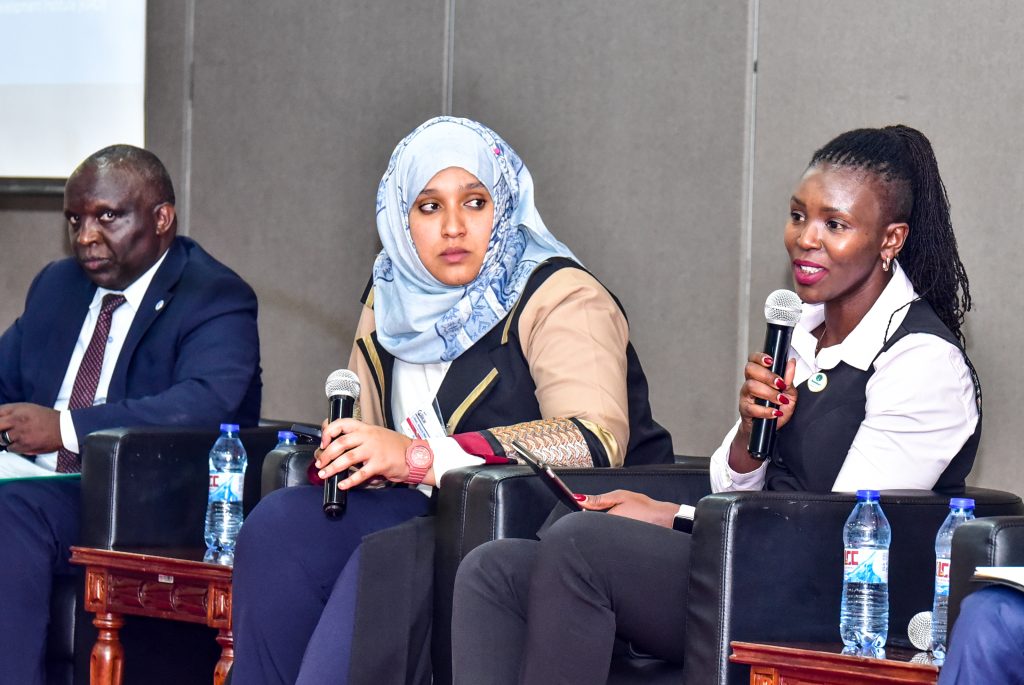
Bamburi Cement Plc Sustainability and Corporate Affairs Director Eng Jane Wangari stresses a point (left), flanked by Kenya Green Building Society CEO Ms Nasra Nanda (centre) and the Industrialisation Secretary, at the Ministry of Investments, Trade and Industry, Prof Erastus Gatebe (right) at the Green Industrialisation and Manufacturing Panel session at the ongoing Kenya Industrialisation Summit 2026.
Local cement manufacturers are calling on the government and private sector to embrace low-carbon cement products as Kenya steps up efforts to promote green industrialisation and sustainable construction.
Speaking during a Green Industrialisation and Manufacturing panel at the Kenya Industrialisation Summit 2026, Bamburi Cement Plc Sustainability and Corporate Affairs Director, Eng Jane Wangari, said the company had already developed and introduced environmentally friendly cement products to support the transition to greener construction.
She said the government could accelerate the shift by giving higher scores to low-carbon cement products in public procurement tenders. Including such products in the Central Bank of Kenya’s Green Finance Taxonomy would also encourage more developers and investors to use them.
At the summit, organised by the Ministry of Investments, Trade and Industry, Wangari highlighted Bamburi’s DuraCem Cement, a locally manufactured 42.5-grade product designed for large-scale and marine construction projects.
The cement is sulphate- and chloride-resistant, making it suitable for structures exposed to harsh environmental conditions. Its manufacturing process also incorporates alternative fuels such as rice husks and waste tyres, helping reduce its environmental footprint.
According to Wangari, a 50kg bag of DuraCem produces about 64 per cent less carbon dioxide than ordinary Portland cement, saving approximately 25kg of CO₂ per bag.
“As cement manufacturers, we are actively playing our part in achieving net-zero emissions and supporting green manufacturing. We have demonstrated that producing cement with lower carbon emissions is no longer just an ambition but something that can be achieved,” she said.
She noted that wider adoption of low-carbon cement in both public and private construction projects could significantly reduce emissions while accelerating Kenya’s green industrialisation agenda.
One example is the Makupa Bridge project in Mombasa, where the use of DuraCem helped save more than 10 million kilogrammes of carbon dioxide. The bridge was also designed to withstand exposure to seawater.
Wangari said Bamburi was also advocating for stronger cement standards and independently verified Environmental Product Declarations (EPDs), which would allow buyers and developers to compare the environmental impact of different cement products.
She likened the declarations to nutrition labels on food products, saying they would give consumers clear and verifiable information about the carbon footprint of the materials they purchase.
Beyond its focus on sustainable construction, Bamburi is positioning itself to play a bigger role in Kenya’s growing infrastructure and industrial development.
Last month, the company announced that it was well placed to supply more than one million tonnes of cement for the proposed Dangote East Africa Petroleum Refinery and Petrochemical Special Economic Zone in Lamu County.
The company is pursuing a commercial opportunity to supply cement and concrete products throughout the project’s development, including its low-carbon DuraCem range.
With assurances that the project will prioritise locally manufactured products, Bamburi is looking to provide cement suited to large-scale and marine construction requirements.
The company has previously supplied cement and concrete solutions for several major national projects, including Talanta Sports Stadium, the Rironi-Mau Summit Road, the Standard Gauge Railway, Dongo Kundu Highway, Mwache Dam, Thwake Dam and Makupa Bridge.
As part of the Amsons Group, Bamburi is also investing in expanding its production capacity and strengthening its long-term clinker supply to meet growing demand from Kenya’s construction and infrastructure sectors.
Late last year, the company signed a US$250 million (approximately KSh32 billion) Engineering, Procurement and Construction (EPC) agreement with China’s Sinoma CBMI Construction Co. Ltd to build a new clinkerisation plant in Matuga, Kwale County.
The facility, with an annual production capacity of 1.6 million tonnes, will incorporate advanced technologies aimed at improving efficiency and reducing environmental impact.
The investment forms part of Bamburi’s strategy to more than double its clinker production capacity from one million tonnes to 2.6 million tonnes annually, while increasing cement production capacity from 1.8 million tonnes to four million tonnes.
The expansion is expected to strengthen the company’s ability to supply quality cement and concrete products while supporting Kenya’s infrastructure development and wider economic growth.