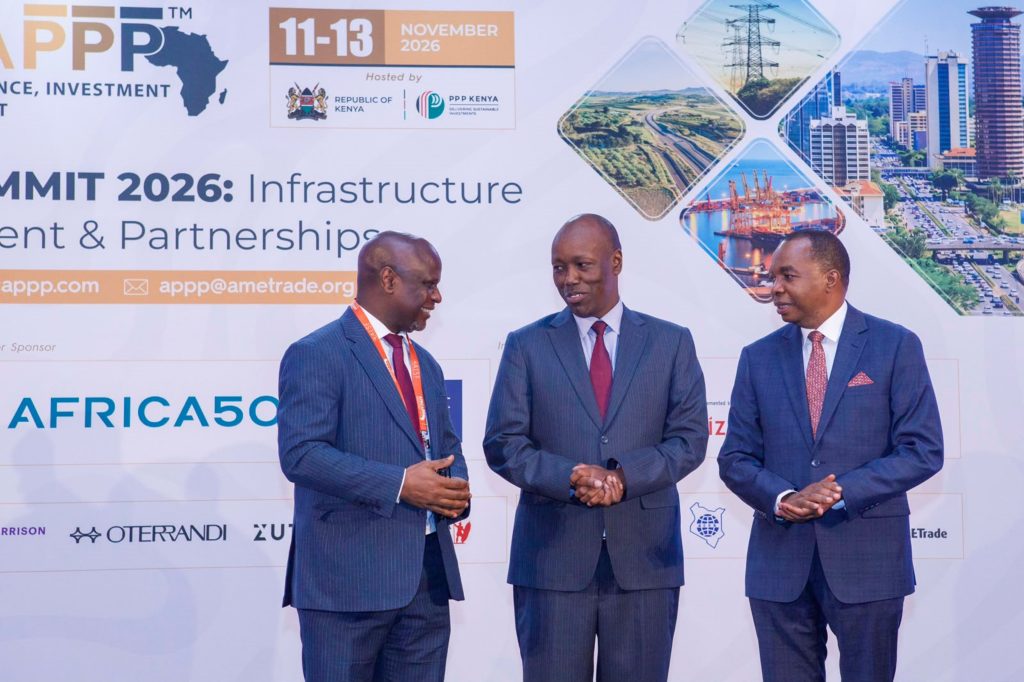
(L-R) Robert Lisinge, Director of the Technology, Innovation, Connectivity and Infrastructure Division at the United Nations Economic Commission for Africa (UNECA), engages with the Cabinet Secretary for Investments, Trade and Industry, Kenya, Hon. Lee Kinyanjui, and Minister of Works, Tanzania, Hon. Masanja Kung'u Kadogosa, during the inauguration of the Africa PPP 2026 Summit in Nairobi. The summit brought together government leaders, investors and infrastructure stakeholders to explore opportunities for stronger investment partnerships, improved infrastructure financing and regional integration.
· As at 30th September 2026, Kenya had a pipeline of 60 PPP projects, comprising 54 national government projects and six county government projects. Ten projects, with an estimated investment value of approximately KSh. 353 billion, are under implementation, while the remaining 50 are at different stages of project preparation and development.
· The Government of Kenya is targeting at least KES70 billion in additional private investment through PPPs during the current financial year
· The Nairobi summit highlights the opportunity to turn Africa’s KES520 trillion in domestic capital into bankable infrastructure projects through effective partnerships, better risk management and stronger investment frameworks.
Africa must strengthen project preparation and develop bankable infrastructure proposals to attract more private investment, as the continent seeks to bridge its infrastructure financing gap despite having trillions of shillings in domestic capital, delegates at the Africa PPP 2026 Summit have heard.
The call was made during the official launch of the 16th Africa PPP Infrastructure Finance, Investment and Partnerships Summit in Nairobi on Friday, November 13, where more than 400 delegates from 36 countries gathered to explore ways of accelerating infrastructure development through public-private partnerships (PPPs).
The discussions focused on how governments can turn available domestic capital into viable infrastructure projects through stronger investment frameworks, effective partnerships and better risk management.
Kenya’s PPP programme illustrates the scale of investment opportunities available. As of September 30, 2026, the country had a pipeline of 60 projects, comprising 54 national government projects and six county government projects.
Ten projects, with an estimated investment value of approximately KSh353 billion, are under implementation, while the remaining 50 are at different stages of project preparation and development.
The Government is targeting at least KSh70 billion in additional private investment through PPPs during the current financial year, following the approval of seven new projects in the first quarter.
Of the 10 projects under implementation, six are operational while four are under construction. They include the KSh183 billion Nairobi–Nakuru–Mau Summit Highway, highlighting the potential of private-sector participation in delivering large-scale infrastructure.
The Kenyan experience reflects a broader continental challenge. Africa requires between US$130 billion and US$170 billion annually for infrastructure investment, but faces an estimated financing gap of between US$68 billion and US$108 billion.
This is despite more than US$4 trillion in domestic savings and assets held across the continent, raising questions about how governments can mobilise available capital and channel it towards infrastructure development.
The summit, hosted by Kenya’s Public Private Partnerships Directorate and organised by AME Trade Limited, with support from the State Department for Public Investments and Asset Management, is being held under the theme, “Building Africa’s Prosperity: Transformative Infrastructure, Investment and Partnerships to Accelerate Economic Development.”
During the launch, Cabinet Secretary for the National Treasury and Economic Planning John Mbadi, who was represented by Investments, Trade and Industry Cabinet Secretary Lee Kinyanjui, called for a shift in how African governments measure infrastructure development.
He said progress should not be judged solely by financing commitments or the number of projects announced, but by the actual infrastructure and services delivered to citizens and businesses.
“The real test of infrastructure development is much simpler: When will the road be completed? When will the water flow? When will the electricity reach the factory? And when will the jobs be created?” Mbadi said in his speech.
He added that public-private partnerships offered an opportunity to bring together government priorities and private-sector investment to accelerate economic and social development.
Principal Secretary in the State Department for Public Investments and Asset Management Cyrell Wagunda said governments needed to strengthen project preparation to reduce delays and improve investor confidence.
“We must invest adequately in feasibility studies, technical assessments, environmental and social safeguards, land acquisition planning and appropriate risk allocation. These issues must be addressed early to avoid delays during negotiations and implementation,” Wagunda said.
PPP Directorate Director General Kefa Seda urged delegates to use the summit to share practical knowledge, engage openly and develop solutions to the challenges facing infrastructure investment across Africa.
Making infrastructure projects investable
A central focus of Africa PPP 2026 is the gap between capital available in African financial markets and the amount reaching infrastructure projects.
Delegates are examining why pension funds, insurance companies, banks and other institutional investors remain underrepresented in infrastructure financing, as well as the measures needed to address barriers to investment.
Discussions are covering project bankability, blended finance, domestic capital mobilisation, risk management and commercially sustainable infrastructure models.
The summit is also emphasising the need to help projects move beyond planning and reach financial close and implementation.
A project preparation masterclass held on Wednesday, November 11, provided guidance on developing proposals that meet investor requirements.
A dedicated deal room, business breakfast and technical visits are also providing opportunities for project owners to engage potential financiers and explore investment partnerships.
The 2026 edition marks the second time Kenya has hosted the summit, following the third edition in 2011.
Its return comes as African governments seek alternative financing models to accelerate infrastructure delivery while limiting unsustainable pressure on public budgets.