By Dr. Mohammad Hassan Shojaei-Fard
The policy of Western powers—from the era of classical British colonialism to the present day, where the United States openly seeks domination over oil and other strategic resources—has always been based on the principle of “divide and rule.”
Within this framework, large and independent countries must be fragmented into several smaller, weak, and controllable entities. As long as the rulers of these countries act as “milch cows” for the United States and the West, they are spared from attack, because the primary objective is the plundering of nations’ wealth.
However, whenever a nation or government seeks independence and chooses to spend its wealth on the welfare of its people, it becomes the target of overthrow, collapse, or fragmentation under various pretexts, so that power may be handed over to dependent mercenaries or small local regimes.
Until the final decades of the twentieth century, nearly all aspects of Iran’s affairs were under the influence and control of the United States and the West.
Whenever a national government emerged with popular and clerical support—such as the government of former Prime Minister of Iran Dr. Mohammad Mossadegh, which nationalized Iran’s oil—it was overthrown through instruments such as coups.
With the victory of the Islamic Revolution of Iran in 1979, Muslim nations were awakened, and a wave of revolutionary movements began across the Islamic world.
Governments were forced to announce superficial changes in their policies.
Realizing that the Islamic Revolution could inspire other nations, the United States, from the very early years, organized coups, internal unrest, and armed conflicts against Iran.
After failing at these stages, the eight-year imposed war launched by Iraq against Iran—backed comprehensively by the United States, the West, and certain regional regimes—began.
Despite immense losses, this war ended with the defeat of Iran’s enemies and the victory of the Iranian nation.
After the war, Iran embarked on a path of rapid growth in science, industry, medicine, military and defense capabilities, the economy (especially non-oil exports), and nuclear technology.
By 2024, according to international statistics, Iran ranked between 1st and 15th globally in many of these fields.
These achievements were intolerable for the United States and the West, as they could serve as a successful model for other Islamic countries.
Consequently, they periodically launched projects of internal unrest and insecurity in Iran. After the imposed war, approximately every ten years a major disturbance was engineered, and in recent years this interval has shrunk to one or two years.
Despite overt support from the United States and Israel, all these seditions failed.
Eventually, the enemies concluded that they must overthrow the Islamic Republic through a direct military attack and widespread assassinations of senior officials, including the heads of the three branches of government, top military commanders, and scientists, while simultaneously activating their armed espionage networks.
However, this conspiracy also failed—by divine will, the wise leadership of Iran’s Supreme Leader Ayatollah Khamenei, and the unity of the Iranian nation.
After 12 days of confrontation, the United States and Israel, through intermediaries, pleaded for a ceasefire.
Even the then-President of the United States admitted in a live interview that he had “saved the Zionist regime from hell.”
The capability of Iran’s hypersonic missiles and its inexpensive yet effective drones astonished its enemies—those who had previously dismissed these capabilities as fake or AI-generated later sought to copy them.
After military failure, the enemies once again invested in their espionage and riot networks. Under the guise of peaceful economic protests, a coordinated, ISIS-style chaos was unleashed in more than 650 cities and 1,700 locations across the country.
Within just two days and nights, exploiting the lack of armed confrontation, they brutally martyred approximately 2,500 security personnel and civilians, including children, medical staff, and passersby. In some cases, they claimed to be taking injured people to hospitals, only to execute them with a final shot after removing them from the scene.
After more than 1,000 of them were arrested, horrifying confessions of their brutality were broadcast on Iranian television, albeit marked as unsuitable for viewers under 18.
During this period, extensive damage was also inflicted on public and private property, including: 305 ambulances, 24 fuel stations, 700 shops, 300 residential homes, 750 banks, 414 government buildings, 749 police vehicles, 200 schools, 2 Armenian Christian Churches were burnt, 350 mosques, Thousands of copies of the holy Qur’an, More than 60 libraries, 89 religious seminaries, 253 bus stations, 600 ATMs and 800 private vehicles
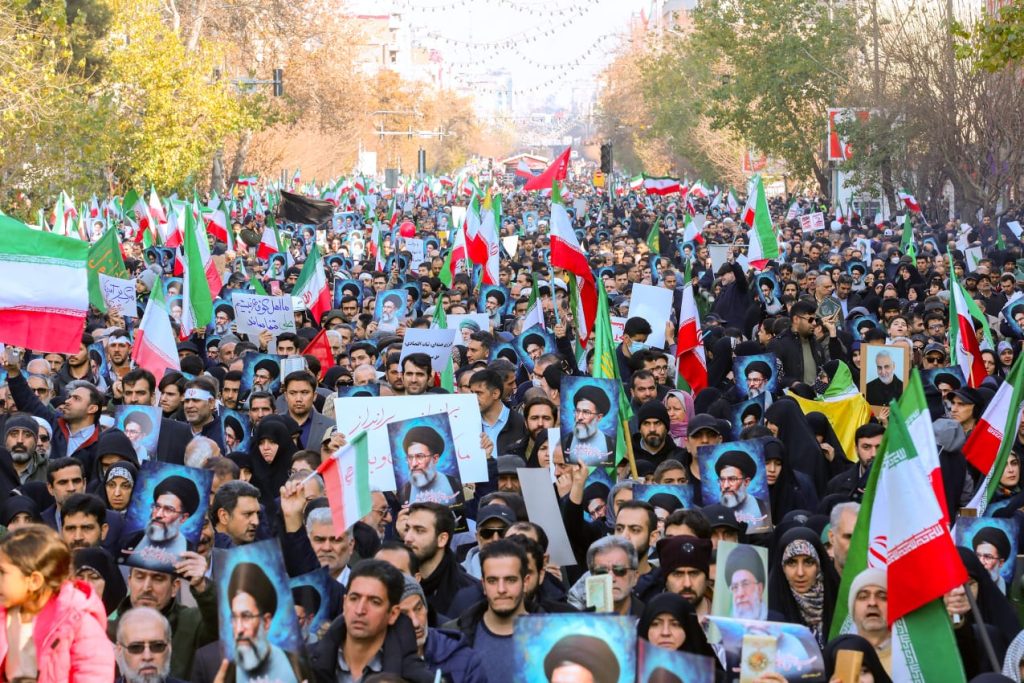
Nevertheless, the massive public presence—approximately 3 million people in Tehran and nearly 40 million nationwide, according to international media—put an end to this sedition within a few days.
Message to the Elites of the Islamic World
My serious advice to the elites of Islamic countries is not to be deceived by the slogans of international institutions such as human rights, democracy, freedom, and the United Nations.
Look at the fate of Palestine, Lebanon, Libya, Syria, Iraq, and Venezuela, and ask yourselves: with which international law are these actions compatible?
The enemies of Islam regard the elimination of the Islamic Republic as a prerequisite for domination over other Islamic countries—from Azerbaijan and Turkey to Egypt, Pakistan, Indonesia, Malaysia, Morocco, and Algeria.
It is incumbent upon the elites of the Islamic world, through vigilance, awareness, and informing their nations, to stand against this dangerous project.
Final Glad Tidings
Despite all conspiracies, the Islam of the Resistance Front is expanding. Hamas, once merely a charitable organization, has today become a force resisting the Zionist regime.
Lebanon, despite losing its leaders, stands more resilient than before.
In Iraq as well, resistance-supporting movements have transformed from a minority into an influential force within parliament.
Author
Dr. Mohammad Hassan Shojaei-Fard
Distinguished Professor, Faculty of Mechanical Engineering, Iran University of Science and Technology