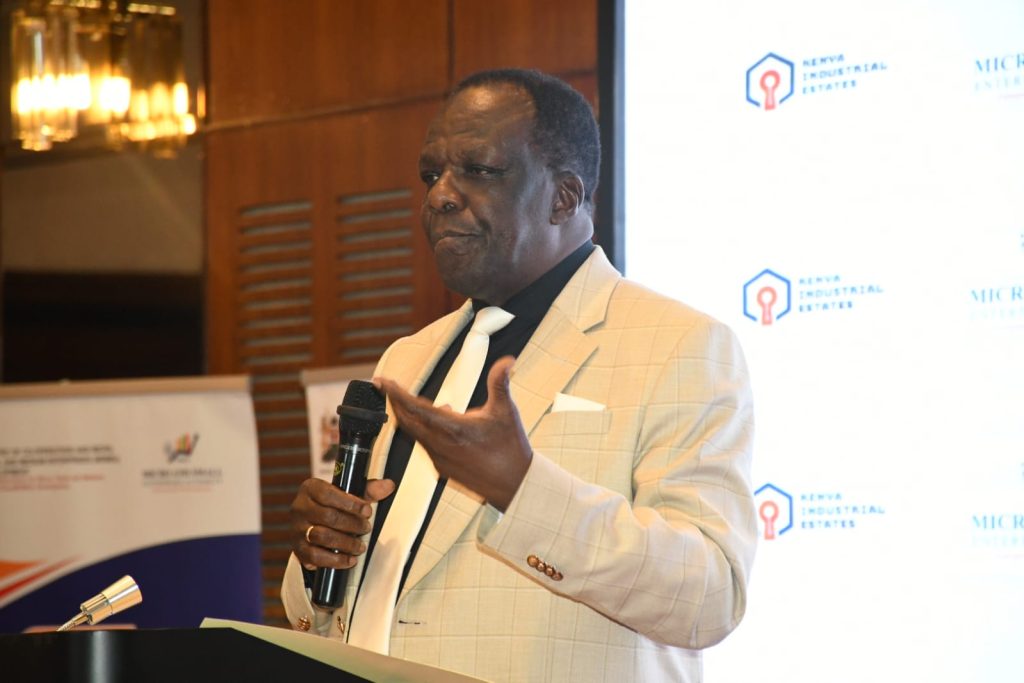
The government has urged the media to take a more active role in promoting accurate and informed reporting on Kenya’s micro, small and medium enterprises (MSMEs), saying the sector remains the backbone of the country’s economy and a key source of jobs.
Speaking during a media breakfast and training session ahead of the 2026 World MSME Day celebrations, Cabinet Secretary for Cooperatives and MSMEs Development Wycliffe Oparanya said journalists are critical partners in educating the public on government programmes aimed at supporting entrepreneurs while helping to combat misinformation.
The forum brought together journalists, communications professionals and chief executive officers from various state agencies to enhance understanding of key government initiatives targeting the MSME sector. Among the programmes discussed were the National Youth Opportunities Towards Advancement (NYOTA) programme and the Kenya Jobs and Economic Transformation (KJET) Project.
World MSME Day is marked globally every June 27 following a resolution by the United Nations General Assembly in 2017. This year’s celebrations mark the 10th anniversary of the observance.
The global theme for this year’s event is “Empowering MSMEs through Innovation and Sustainable Industrial Development,” while Kenya will commemorate the day under the theme “Human-Centred Entrepreneurship in an AI-Driven Future: Economic Empowerment for the Next Generation of MSMEs.”
Oparanya said the national celebrations will be held at the Kenyatta International Convention Centre (KICC) on Saturday and are expected to attract more than 3,000 participants drawn from across the enterprise ecosystem. President William Ruto is expected to preside over the event.
“As artificial intelligence reshapes how we work, produce and trade, our duty is to keep people, our entrepreneurs and our young people, firmly at the centre of that transformation,” Oparanya said.
The Cabinet Secretary noted that Kenya is home to about eight million MSMEs, which employ nearly 15 million people, contribute 34 per cent of the country’s Gross Domestic Product (GDP) and generate approximately 91 per cent of all new jobs annually.
“These are not abstract numbers. When we speak of MSMEs, we are speaking about the livelihoods of the majority of Kenyan families and the future of our economy,” he said.
According to Oparanya, nearly one million young Kenyans enter the labour market every year, making the growth of small businesses crucial in creating employment opportunities.
He highlighted several government initiatives under the Bottom-Up Economic Transformation Agenda (BETA) aimed at supporting the sector. They include the Financial Inclusion Fund, popularly known as the Hustler Fund, the Sh29 billion NYOTA programme implemented in partnership with the World Bank, the Kenya Jobs and Economic Transformation (KJET) Project, the Credit Guarantee Scheme and financing offered through institutions such as Kenya Industrial Estates, the Women Enterprise Fund, the Youth Enterprise Development Fund and the Kenya Development Corporation.
Oparanya also welcomed the recent decline in interest rates, saying the Central Bank of Kenya’s decision to lower its benchmark lending rate had reduced borrowing costs and was expected to stimulate private sector lending.
However, he acknowledged that access to finance remains one of the biggest challenges facing MSMEs, with the financing gap running into trillions of shillings.
“The next phase of our agenda is to move from government-led support to market-led support,” he said.
He added that banks, development partners, technology innovators and investors would be encouraged to develop financing solutions that lower lending risks and expand access to affordable capital for small businesses.
Meanwhile, Micro and Small Enterprises Authority (MSEA) Director General Henry Rithaa said the authority continues to strengthen and formalise the sector through business development training, market access programmes, affordable financing, incubation services and the provision of common user production facilities.
Rithaa said the initiatives are aimed at building competitive, resilient and sustainable enterprises capable of creating jobs and driving economic growth.
The Ministry maintained that stronger collaboration with the media will help ensure entrepreneurs across the country are aware of the opportunities, financing options and support services available to grow their businesses.
Oparanya challenged the media to play a more proactive role in telling the MSME story by highlighting both the gains made and the challenges still facing the sector.
The Cabinet Secretary made two key appeals to journalists: to report accurately on the true scale and impact of MSMEs and to participate in the national celebrations at the Kenyatta International Convention Centre (KICC).
“Help us tell this story fully and accurately: the true scale of the sector, the progress we have made and the work that still lies ahead,” Oparanya urged.
He emphasized that the future of Kenya’s economy lies in the hands of small businesses, including informal traders and young innovators.
“The future of Kenya’s economy will be built by its small businesses, by the mama mboga, the boda boda rider, the artisan and the young innovator. Let us give them the financing, the markets and the confidence they need to grow,” he said.