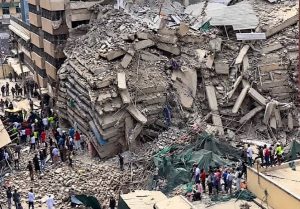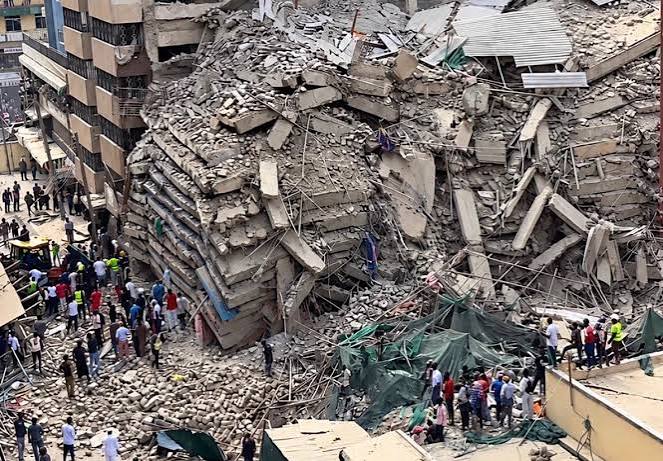
Two Somali businessmen have been identified among the owners of the company linked to the 18-storey building that collapsed along 9th Street in Eastleigh, Nairobi, raising fresh questions about the project’s approvals, construction and the circumstances that led to the tragedy.
The businessmen, Mohamed Khatar Ali Noor and Abdikadir Abdi Sheikh, alongside Abdifatah Ali Noor, are listed in company records as owners of 9th Street Plaza Limited, the developer registered with the National Construction Authority (NCA) for the ill-fated project.
According to reporting by the Daily Nation and Kenya Insights, Mohamed Khatar Ali Noor holds the majority of shares in the company.
The collapse has triggered scrutiny of the developer, the contractor, construction professionals and government agencies responsible for ensuring that buildings comply with safety regulations.
In an interview with the Daily Nation, Mohamed Khatar Ali Noor reportedly maintained that the building had the necessary approvals. He also said he had not been contacted by investigators as of Monday evening.
His account differs from that of Nairobi Governor Johnson Sakaja, who has maintained that the county government did not approve the building’s architectural plans.
The competing accounts have intensified calls for investigators to establish who authorised the construction, whether the required approvals were obtained and who should bear responsibility for the collapse.
Company Records Place Businessmen at Centre of Ownership Questions
The National Construction Authority identified 9th Street Plaza Limited as the developer on record when the building collapsed on Friday, October 23.
The project was registered with the authority on July 30, 2025, under registration number 53128815710410.
Company records cited by the Daily Nation identify Mohamed Khatar Ali Noor, Abdikadir Abdi Sheikh and Abdifatah Ali Noor as shareholders in the development company.
The company structure has brought the businessmen into focus as investigators seek to establish the respective responsibilities of the project’s owners and other parties involved in its construction.
However, company ownership alone does not establish individual criminal liability. Investigators will need to determine each person’s role in the development, the decisions made during construction and whether any laws were violated.
Dispute Over Building Approvals
Governor Sakaja has insisted that Nairobi County approved a change of user for the property but did not approve the architectural or building plans for the high-rise structure.
According to the governor, a document circulating online and purportedly showing building approval was fraudulent.
He has maintained that county officials had previously flagged the development and issued enforcement notices, including orders to stop construction.
The county’s position raises questions about how construction continued despite the reported enforcement measures and whether the authorities took sufficient steps to prevent the building from being occupied.
The Daily Nation reported that an application for architectural plans for a 15-storey building with a basement, submitted on November 20, 2024, was not approved, according to county records.
The building’s eventual height and the circumstances surrounding its construction are now central to the investigations.
Contractor and Professionals Also Under Scrutiny
Besides the developers, Stromax Holdings E.A. Limited was listed as the contractor for the project, with John Karuga Ng’ang’a identified as its director.
The NCA also listed architect Emmanuel Mwangi Maina and structural engineer Joseph Muturi Mugu among the professionals associated with the project.
Mugu has disputed the extent of his involvement and said, through his advocates, that he had sought project records from the relevant authorities to establish how his details were included.
The allegations and competing accounts involving the developer, contractor and professionals have yet to be conclusively resolved.
Investigators will need to establish whether the building complied with approved structural designs, construction standards and other statutory requirements.
DPP Orders Investigations
The Office of the Director of Public Prosecutions has said it had not received an inquiry file from Nairobi County concerning alleged wrongdoing by the developer, construction professionals or county officials involved in the project.
Read more: South B MCA Challenges Sakaja Over Eastleigh Collapse Claims
The DPP subsequently directed the Directorate of Criminal Investigations to investigate the circumstances surrounding the collapse, including whether acts or omissions by public officials, the developer, contractors or professionals contributed to the disaster.
The investigation is expected to examine the approvals process, enforcement actions and the responsibilities of the various parties involved.
The findings could determine whether individuals or companies should face criminal charges or other legal consequences.
Families Await Answers
The collapse has left families searching for missing relatives and survivors struggling to come to terms with the loss of livelihoods and property.
The disaster has also renewed concerns about building safety in Nairobi, particularly in areas experiencing rapid commercial and residential development.
As investigations proceed, attention remains focused on 9th Street Plaza Limited and the people and institutions connected to the project.