By Njeri Irungu.
Kenya has unveiled a new national innovation platform aimed at accelerating scientific research, supporting local innovators and positioning the country as a global hub for technology and sustainable development.
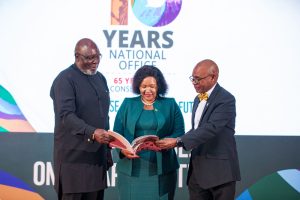
Speaking during the closing ceremony of the inaugural Science, Technology, Research and Innovation for Society (STRI4SOCIETY) Week at the Kenyatta International Convention Centre, Director General of the National Commission for Science, Technology and Innovation Dr. Shaukat Abdulrazak announced the establishment of the Grand Challenge Kenya Platform, which will provide funding and support for researchers and innovators tackling development challenges.
The week-long conference brought together more than 5,000 stakeholders, including scientists, policymakers, students, development partners, diplomats, investors and industry leaders to deliberate on the role of science and innovation in national development.
Dr. Abdulrazak said the conference featured 34 scientific presentations covering areas such as climate change, health, artificial intelligence, biodiversity, digital transformation, communication technologies and sustainable development.
“These sessions provided a fundamental platform for knowledge exchange, interdisciplinary dialogue, networking and collaboration among researchers, policymakers, academia, industry and global partners,” he said.
He noted that the event also focused on mentorship and encouraging young people, particularly girls, to pursue careers in science, technology, engineering and mathematics (STEM).
According to Dr. Abdulrazak, Kenya will release support for six high-risk scientific grants of up to 300,000 US dollars each under the newly launched Grand Challenge Kenya Platform. He added that the programme will also provide transition funding of up to 350,000 US dollars for promising innovations over a five-year period.
“Kenya now joins a growing community of African nations including Senegal and Nigeria, alongside countries such as the United Kingdom, India, Brazil and South Korea that have established National Grand Challenges within a wider global innovation-driven system,” he said.
Dr. Abdulrazak further called for increased investment in research ecosystems, stronger university-to-university collaboration and the establishment of research chairs in universities and research institutions to strengthen mentorship, attract global talent and align scientific research with national priorities.
He emphasized that the true value of research lies in developing practical solutions that improve society rather than focusing solely on academic publications.
“We must therefore strengthen the university’s responsibility to translate research into jobs, enterprises, patents, products, policies and solutions,” he said.
Prime Cabinet Secretary and Cabinet Secretary for Foreign and Diaspora Affairs Musalia Mudavadi, who officially closed the event, described the inaugural STRI4SOCIETY Week as a significant step towards integrating science and innovation into Kenya’s national development agenda.
“The theme of this event, Igniting Innovation: Bridging Science and Society for Sustainable Development, captures our ambition and responsibility to see the true value of science in its transition from discovery to application,” Mudavadi said.
He said the event reaffirmed Nairobi’s growing position as a regional science, technology and innovation hub and aligned with President William Ruto’s vision of placing science and innovation at the centre of Kenya’s socioeconomic transformation.
Mudavadi noted that Kenya had recently launched the Kenya Science, Research and Innovation Synergy Blueprint, a framework aimed at integrating and accelerating the country’s research and innovation ecosystem.
He acknowledged that while Kenya had made significant progress in science and innovation, challenges still existed in governance, coordination and strengthening collaboration between research institutions, universities and industry players.
“I am confident that the establishment of the State Department for Science Research and Innovation will help resolve the coordination and governance issues,” he said.
Mudavadi also assured stakeholders of the Government’s commitment to increasing funding for research, science and innovation to at least two percent of Kenya’s Gross Domestic Product to support commercialization of research and growth of viable enterprises.
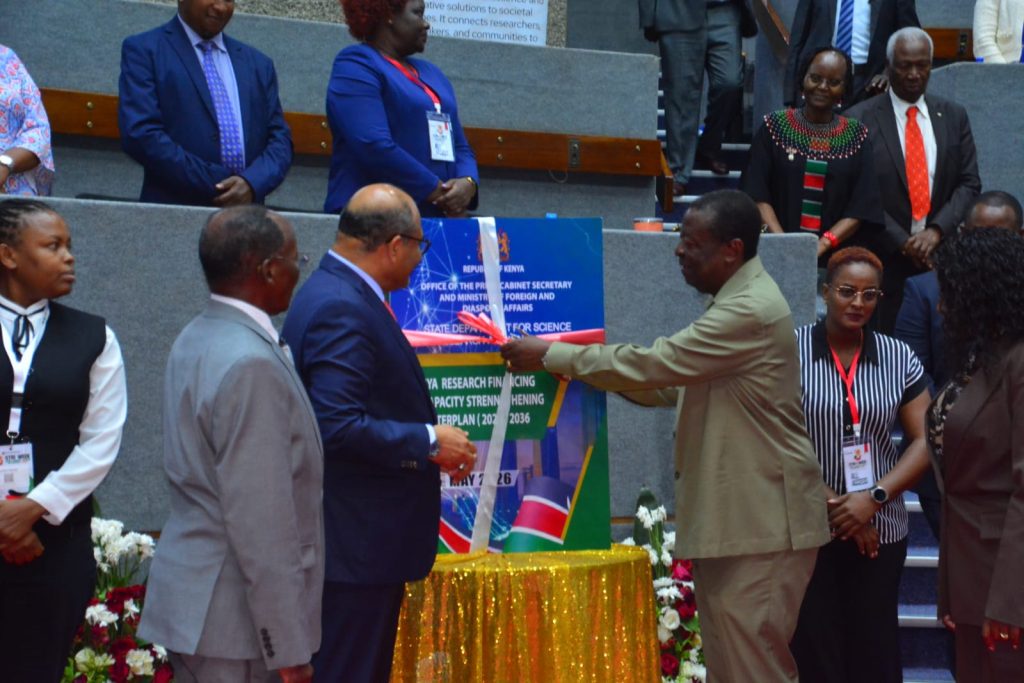
The Prime Cabinet Secretary welcomed the launch of the Grand Challenge Initiative and the planned Masterplan for Research Financing and Capacity Strengthening, which is supported by the United Kingdom’s Foreign, Commonwealth and Development Office.
He urged participants to continue strengthening collaboration networks and advancing the resolutions reached during the conference.
“It is now my pleasure to declare the inaugural Science, Research, Technology and Innovation for Society Week officially closed,” Mudavadi said.