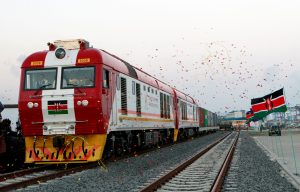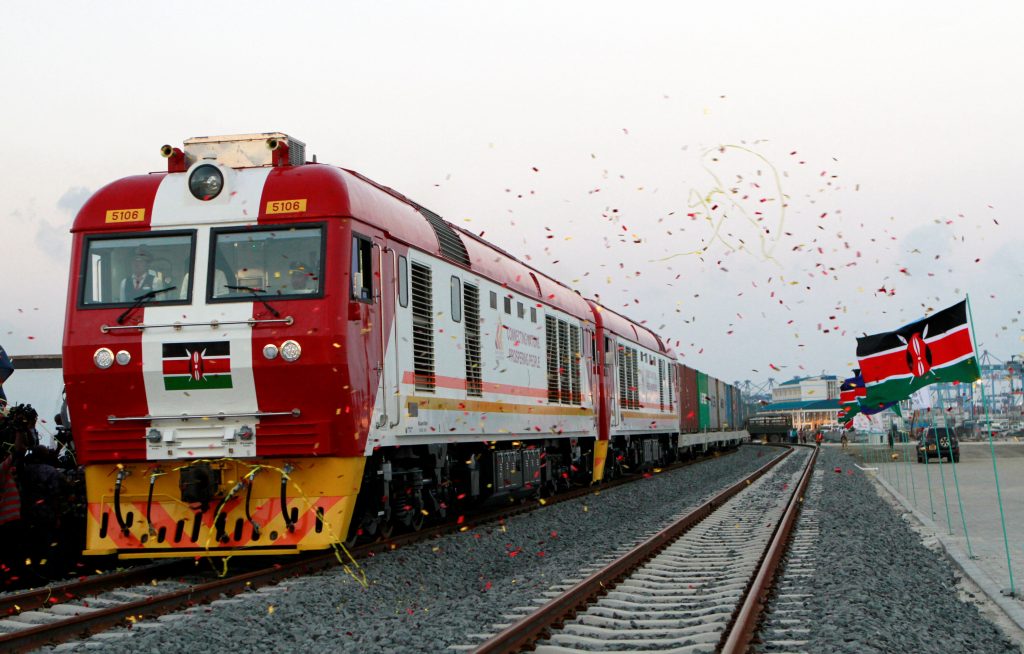
A cargo train is launched to operate on the Standard Gauge Railway (SGR) line constructed by the China Road and Bridge Corporation (CRBC) and financed by Chinese government in Kenya's coastal city of Mombasa, May 30, 2017. REUTERS/Stringer TPX IMAGES OF THE DAY - RTX389W3
Kenya Railways has underscored its commitment to meeting its loan obligations, pointing to disciplined financial stewardship and decisive leadership as the driving forces sustaining the giant transporter’s resolve to stay current on its debt obligations.
Last year while addressing lawmakers and stakeholders, Kenya Railways Managing Director Philip Mainga reaffirmed that the corporation has not defaulted on the multi-billion-shilling loans taken to construct and develop the Standard Gauge Railway (SGR), and reiterated plans to retire the debt fully by 2028.
Mainga’s strong messaging on debt discipline comes at a time when the government has been negotiating broader fiscal reforms to relieve pressure on public finances.
In late 2025, Treasury confirmed that Kenya had completed a major restructuring move — converting the SGR’s outstanding Chinese loans from U.S. dollars to Chinese yuan.
Data released in February 2026 by the Controller of Budget, Dr Margaret Nyakang’o, showed that this shift helped save the country around $167 million in debt-servicing costs, with Kenya remitting Ksh37.5 billion in January’s semi-annual repayment — a marked decline from last year’s figures.
Analysts and officials say the switch to yuan has helped insulate Kenya Railways’ debt profile from sharp exchange-rate movements that had previously made servicing more costly. It also reflects a broader government strategy to stabilise debt flows and ease repayment pressure without compromising key infrastructure goals.
While revenue challenges persist in the rail subsector, Kenya Railways has recorded notable operational improvements.
In October 2025, the corporation announced that it had moved 640,000 tonnes of cargo, the highest monthly total since the introduction of the Madaraka Express freight service in 2017 — a sign that the SGR is increasingly anchoring cargo movement in the region.
Mainga has also overseen steps toward enhanced localisation of SGR operations, with a near-complete takeover of functions previously managed by foreign partners. This, commerce observers say, sets a foundation for stronger revenue performance and more direct financial control by the corporation — both of which matter when balancing loan servicing with daily operations
Experts caution that broader structural challenges remain, noting that past audits have flagged accumulated interest and penalties arising from earlier servicing gaps, and that SGR revenues alone have historically fallen short of covering costs. But supporters of Kenya Railways’ leadership argue that Mainga’s focus on prudent financial management, combined with government support and debt restructuring, has positioned the corporation to meet its obligations without resorting to missed payments.
“Maintaining that no default has occurred and setting a clear roadmap toward full repayment reflects strong leadership and accountability,” said one industry analyst who asked not to be named.
As Kenya readies for further phases of the SGR and works to integrate rail into its broader transport backbone, the corporation’s ability to balance infrastructure ambitions with debt discipline will remain under close scrutiny — both in Parliament and across the wider economy.